
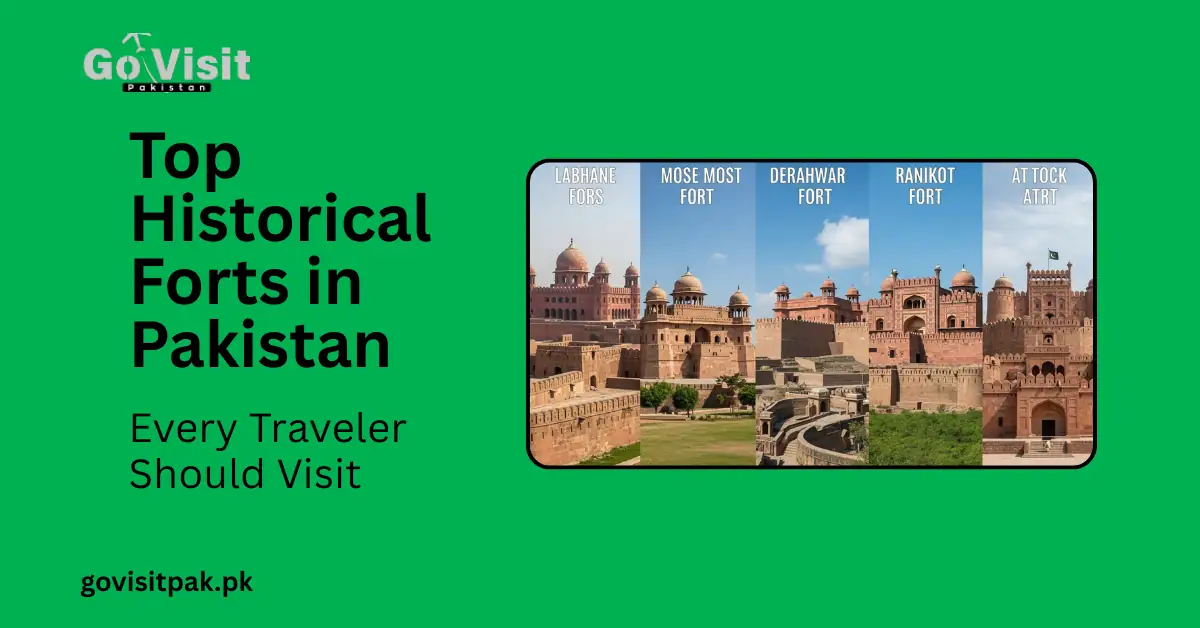
In this blog you will learn about the mostTop Historical forts of Pakistan and their history.
Pakistan houses numerous ancient forts that reveal its long history, robust culture, and royal heritage.
The kings constructed these forts for protection and power. They are not structures — they are tales of stone.
You will learn about stunning forts such as Lahore Fort, Rohtas Fort, Baltit Fort, Derawar Fort, and Ranikot Fort.
Each of them exhibits art, courage, and craftsmanship. People who visit these forts gain insights into Pakistan’s history and keep
the heritage of the country alive for generations to come.
Pakistan is a nation with incredible history and stunning culture. When we observe its ancient buildings,
the forts in Pakistan tower high as monuments of strength and pride. These forts were constructed by great kings to defend their people and demonstrate their power.
They are not mere walls of stone — they are tales of courage, art, and culture.
Pakistan has a rich array of ancient forts and castles that are strong symbols of its multicultural history and heritage.
Constructed by different rulers as a defense, royal residence, and control of the army,
these buildings are disseminated all over the country, ranging from the deserts of Sindh and Punjab to the mountainous areas of Gilgit-Baltistan.
- These forts make us remember about Pakistan’s culture and heritage tourism.
- They reveal how people lived, struggled, and constructed during ancient times.
- Visitors from around the world visit these magnificent forts.
- Each fort has a story about its rulers and their craftsmanship.
Visiting these forts is like stepping into the past, where each stone tells the tale of Pakistan’s grandeur.
How Do Forts Reflect Pakistan’s Culture and Heritage Tourism?
Forts are a large part of culture and heritage tourism in Pakistan.
They exhibit the way the country’s culture evolved over time. These forts attract visitors
who are interested in learning about former kings, queens and empires. They allow tourists to understand how Pakistan appreciates history and art.
The historical forts of Pakistan are rich in design, carvings and vibrant tales.
People stroll through them to experience the culture that lives in each brick.
- The heritage sites of Pakistan are promoted by forts.
- Mughal, Afghan and local architectural excellence are revealed by forts.
- Every fort contains a tale of courage, faith and leadership.
- Tourism of forts in Pakistan makes people aware of history in an entertaining manner.
Through these forts, Pakistan shares its identity with the world. It’s like opening a book where every page is written with love, bravery and beauty.
Why Is Lahore Fort Called the Heart of Mughal Art?
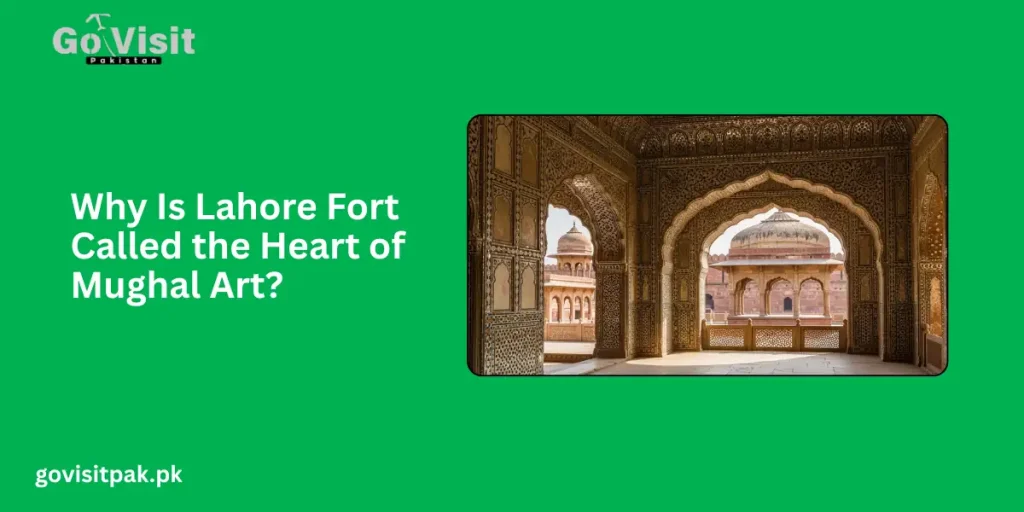
The Lahore Fort is among the most renowned historic monuments of Pakistan.
It proudly sits within the Walled City of Lahore and is famous for its stunning Mughal architecture.
The fort is dotted with vibrant walls, palaces, and gardens constructed by Mughal emperors.
This Pakistan heritage site is also a World Heritage site of UNESCO.
Within it, you observe the Alamgiri Gate, Sheesh Mahal and marble pavilions glimmering in sunlight.
Each wall is a tale of love and art.
- Constructed and enlarged by Akbar, Jahangir and Shah Jahan.
- Comprises majestic gates, gardens and palace rooms.
- A work of Mughal design and art.
- A major draw for culture and heritage tourism.
A visit to Lahore Fort is like going back in time to the Mughal period — when kings trod its marble pavement, and music filled the air.
Why is Rohtas Fort Considered for Its Strength and History?
The Rohtas Fort of Punjab is the strongest fort of Asia.
Sher Shah Suri constructed it in the 16th century. Sher Shah Suri constructed the fort for the purpose of defending his empire and governing local tribes.
It is tall with strong stone walls and high gates.
The Pakistan ancient forts such as Rohtas demonstrate the courage and ingenuity of their constructors.
The fort is also a UNESCO World Heritage site and a finest example of early Mughal military architecture.
- Features 12 massive gates and a 4 km-long wall.
- Constructed for military defense and governance.
- An ideal destination for history enthusiasts and tourists.
- Embodies Pakistan heritage forts.
When you step inside Rohtas Fort, you can sense the might of its stones and the silence of the past that continues to exist in its atmosphere.
Why Should You Visit Baltit Fort in Hunza?
The Baltit Fort is a gem of the Hunza Valley. It is one of the oldest forts in northern Pakistan.
The fort is over 700 years old and occupies a hill having a breathtaking view of the valley.
Its architecture is a combination of Tibetan and Islamic art.
It was the palace of the Hunza rulers in the past and now has been newly restored.
Nowadays, it is a landmark of heritage tourism in the north.
- It is situated in Karimabad, Hunza.
- Constructed of wood, stone and clay with age-old beauty.
- Depicts local life and history.
- A popular destination for tourists who are fond of ancient architecture.
When you go to Baltit Fort, you are able to understand how nature and history come together to form peace and beauty.
Why is Derawar Fort a Wonder of the Desert?
In the center of the Cholistan Desert stands the gigantic Derawar Fort.
It resembles a giant castle among golden sands. The fort is recognized by its square structure and 40 tall bastions that can be spotted from miles away.
The fort was originally constructed during the 9th century and subsequently controlled by the Nawabs of Bahawalpur.
The famous forts of Pakistan such as Derawar depict the strength and beauty of old design.
- Situated in Bahawalpur’s Cholistan Desert.
- Adorned with 40 high walls and towers.
- A favorite destination for desert tourists and photographers.
- An important location in old forts in Pakistan.
Standing alongside Derawar Fort against the vast desert horizon is enchanting — it brings the past and present into harmony.
Why Is Ranikot Fort Named the Great Wall of Sindh?
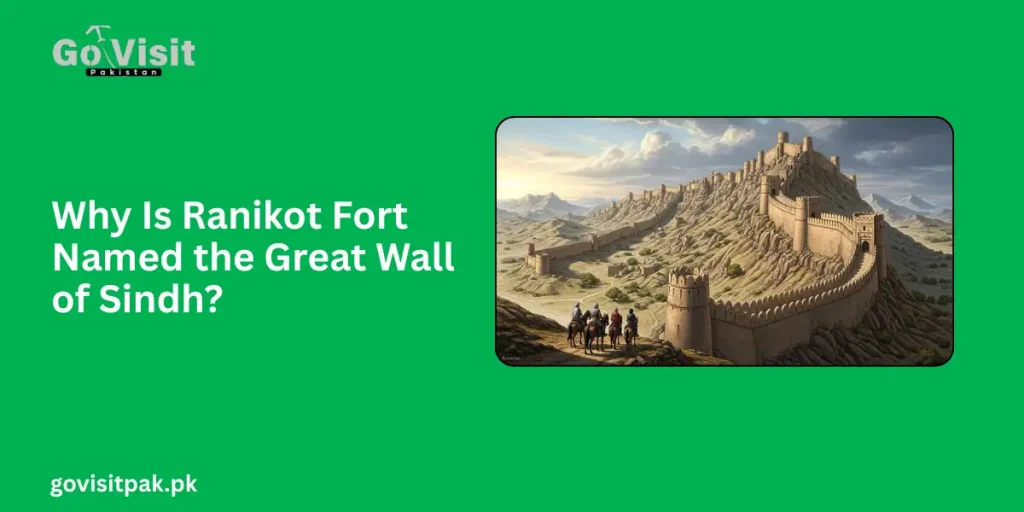
Sindh’s Ranikot Fort is one of the world’s biggest forts. It is often referred to as the “Great Wall of Sindh.”
Its walls are made of stones and go on for approximately 32 kilometers across the Kirthar Mountains.
The fort itself and its enormity contribute to its mystery, which is a marvel of Pakistan’s heritage sites.
Nobody knows when it was constructed, but it is thought to be extremely old and was constructed for defense.
Now, it’s a symbol of Sindh’s power and pride.
- Situated near Jamshoro, Sindh.
- One of the largest forts in the world.
- Excellent for history buffs and tourists.
- Forms part of heritage tourism.
Strolling down its long stone avenue is like laying hands on centuries of history. It is indeed a wonder wall.
Why Is Altit Fort Important for Hunza’s History?
The Altit Fort is one of the oldest structures in Gilgit-Baltistan, dating back over 900 years.
It’s perched atop cliffs and offers views of the Hunza River. The fort reflects the elegance of ancient architecture and the ingenuity of its builders.
It has been restored with great care with assistance from the Aga Khan Trust.
The places to visit in Pakistan such as Altit Fort allow travellers to observe what life used to be like in the mountains.
- It depicts early Balti and Tibetan styles of artwork.
- Restored to preserve history.
- A symbol of heritage and culture tourism in the north.
When you go to Altit Fort, you get to experience how tradition and power are a part of Pakistan’s heart.
What Does Rawat Fort Say?
The Rawat Fort is situated close to Islamabad and has several stories untold.
Built in the 16th century during the Mughal era to protect trade routes,
the fort may be small but full of character, with courtyards and tombs of retired soldiers.
This is one of the Mughal forts in Pakistan that provides us a glimpse into life long ago.
It is no more popular than Lahore or Rohtas, but it is just as rich in history.
- 15 km from Islamabad.
- Constructed by Mughals as a rest and defense station.
- Old mosques and tombs within.
- A serene destination for heritage tourism in Pakistan.
Visiting Rawat Fort is like finding a hidden piece of history — peaceful, serene and rich in stories.
How Beautiful Is the Architecture of Forts in Pakistan?
The architecture of forts in Pakistan is a blend of several cultures — Mughal, Afghan, Persian and traditional local cultures.
Each fort is of a different shape, design and history.
The carvings on stones, the wooden windows and the ornamented walls reflect the craftsmanship of ancient builders.
From Lahore Fort’s marble elegance to Rohtas’s stone might,
each one of them tells us how powerful and imaginative Pakistan’s forefathers were.
- Forts illustrate the cultural heritage of Pakistan.
- They incorporate stone, marble, and wood in incredible ways.
- Mughal forts depict beauty and symmetry.
- Mountain forts illustrate strength and intelligent planning.
These forts are not just structures — they are galleries of historical art, waiting for us to discover.
Why Are Forts Significant in the History of Pakistan?
The Pakistani forts’ historical past speaks about wars, peace and kingship.
The forts guarded cities, kings and wealth. They were also hubs of art and wisdom.
The ancient Pakistani forts represent strength and bravery.
Each of them is a testament to how people lived in the past with purpose and dignity.
- Illustrate history from Mughal, Sikh and British periods.
- Remind us of past rulers and empires.
- Keep accounts of courage and sacrifice alive.
- Facilitate our understanding of culture and heritage tourism.
By retaining these forts, Pakistan preserves its heritage for generations to come.
How Is Fort Tourism Supporting Local Culture?
Pakistan’s fort tourism contributes to the promotion of local culture and sustenance of small communities.
As tourists visit these forts, they purchase local handicrafts, enjoy traditional cuisine and acquire knowledge about customs.
This not only makes the local families earn but also keeps history alive.
The forts become classrooms where everybody learns about heritage sites in Pakistan.
- Provides employment for guides, artists and shopkeepers.
- Encourages traditional music, food and crafts.
- Educates children about history and pride.
Going to forts is not all fun — it’s a way to connect with Pakistan’s heart.
When Is the Best Time to Go to Historical Forts in Pakistan?
The best time to go to historical forts in Pakistan is between the cold months of October to March.
The weather is lovely, and you can comfortably walk around.
Numerous tourists also visit during holidays or festivals to witness the festive aspect of Pakistan’s heritage tourism.
- Winter and spring are the best seasons for visiting forts.
- Forts in the desert are lovely to view at sunrise and sunset.
- Forts in the mountains are prettiest during summer.
- Carry water, some snacks and a camera to capture the memories.
Each season provides another perspective on Pakistan’s beauty — from the northern snow to the southern deserts’ warmth.
What Do Travellers Need to Know Before Visiting Forts in Pakistan?
Travelling to forts in Pakistan is convenient if you are well-planned.
You can travel by car, tour, or on foot if the fort is within walking distance. Make sure to follow the rules and don’t litter.
Tourists must also know a bit about the fort before going there — it adds spice to the trip.
- Take water along and wear good shoes.
- Follow local customs and dress appropriately.
- Take a guide to understand better.
- Help local vendors and artists.
By travelling responsibly, not only do you view the forts but also contribute to the preservation of the forts for future travellers.
Conclusion:
The Pakistan forts are not just a part of history; they are part of our heritage.
These forts link us with the origins of our tradition, courage, and intelligence. Preserving them preserves our tales.
Conserving Pakistan heritage sites allows future generations to look at the rich history of the country.
It instructs everyone to appreciate history and honor what their forefathers created.
- Forts are gems of Pakistan’s history.
- They evoke pride, love, and learning.
- Preservation of them promotes culture and heritage tourism.
- They reveal Pakistan’s true beauty to the world.
Each brick of these forts carries a memory — of kings, soldiers, and artists.
Preservation of them keeps Pakistan’s golden past shining bright forever.
FAQs:
What are Forts in Pakistan?
Forts in Pakistan are ancient and sturdy structures constructed long back by kings and rulers. They were constructed to provide protection to people from invaders. They reflect the country’s rich culture and heritage tourism today and speak of bygone days.
Why were forts constructed in ancient times?
Forts were constructed to safeguard cities and individuals from invasions. They also protected treasures and kings within. Most historical forts in Pakistan were constructed for defense, palace residences, and domination of trade routes.
How many forts exist in Pakistan?
There are approximately 75 historical forts in Pakistan. Each fort is different in its design, history and significance. Some are situated in deserts, others on hills or along rivers, reflecting Pakistan’s vast history and culture.
What is the largest fort in Pakistan?
The Ranikot Fort in Sindh is the largest fort in Pakistan. It is so big that it’s known as the Great Wall of Sindh. Its huge walls are spread over 32 kilometers and appear beautiful along the mountains.
What is the smallest fort in Pakistan?
The Rohtas Fort is referred to as the smallest but strongest fort in Pakistan. It was constructed by Sher Shah Suri for protection and domination. Even now, its gates and walls reflect the strong Mughal power.
What are the different types of fortification?
There are various types of forts and defense walls. Some of them are:
Barricades – ordinary walls to prevent attacks.
Blockhouses– small forts for troops.
Bastion forts– strong forts with high corners.
Border barriers – forts located near country borders.
Blast shelters– safe zones during wars.
All these indicate how ancient rulers defended their territories.
What is the most well-known fort of Pakistan?
The Lahore Fort is the most renowned fort in Pakistan. It is a UNESCO World Heritage Site and a work of art by Mughal architecture. Travellers adore its royal gates, palaces and stunning gardens.
What is the historical significance of forts?
Forts were crucial for the security of individuals and cities. They were strong power and control centers. In culture and heritage tourism Forts remind us about courage, art, and togetherness from the past.
Who constructed the Ranikot Fort in Pakistan?
The architects of Ranikot Fort are not completely known. Some believe it was constructed by people of ancient Amri Culture, and then it was restored by Talpur monarchs. It still remains standing as a marvel of Pakistan’s heritage.
Why should travellers visit the forts in Pakistan?
Tourists should visit the Forts in Pakistan to experience ancient architecture, tales and customs. Each of the forts reflects the magnificence of Pakistan’s culture and heritage tourism and provides tourists with a glimpse into history which exists till date.